
I’ve decided there’s too much good writing in the world to limit my reviews to just one book, so I’ll give you the highlights of some of what I’ve read this past month. More books? You bet. Enjoy!
Last semester, I was talking to one of my English 111 students. He wanted to know why he hadn’t scored well on his paper, so I told him. I explained the essay’s lack of a thesis statement, the missing support for his claims, the tangential paragraphs that took me away from his main ideas, and the incorrect citations and grammatical errors. He listened patiently, then said, “Well, that’s your opinion.”
“No,” I said. “That’s my professional assessment.”
“Whatever,” he said. “I mean, who are you to judge me?”
I was baffled. Before I could explain that evaluating an essay is not a judgment of a person or their worth or intelligence or potential, he left. It was only later that I thought perhaps what he was really asking was why my evaluation of his writing should even matter. The emphasis in the statement was not “judge ME,” but “Who are YOU?”
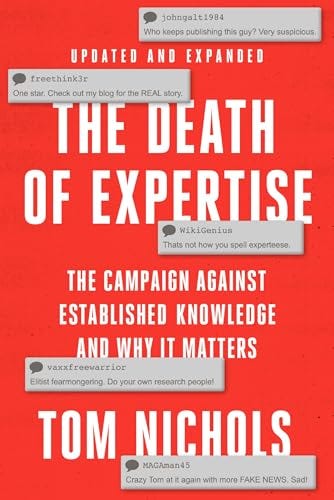
That’s the crux of Tom Nichol’s The Death of Expertise: The Campaign Against Established Knowledge and Why it Matters. Nichols argues we have become a culture that does not value—in fact, it actively disregards—professional expertise. He gives a variety of reasons for this situation: our government, the media, a lack of ability for professionals in various fields to communicate their findings, and, of course, the great equalizer of social media, where everyone’s opinion is published and seen as valid.
This is scary stuff. Because if we don’t trust physicians, scientists, governmental officials, data analysts, environmentalists, and others who can help us navigate this increasingly complex world, we are screwed. Nichols wrote the first edition of this book in 2017. In it, he said that the only thing that may stop the decline of trust in educated professionals’ work would be a global issue, one that required the world to share its experts and their collective knowledge for the public to understand how important their work really is. The newest edition, published in 2024, includes an additional chapter on COVID-19, where he explains his theory didn’t work. Unfortunately, after the pandemic, we are more distrusting now than ever before.
It’s a good read, engaging and well-researched. And it will help you understand a bit more about how people think—and the ways they refuse to do so.
Wow. Just, wow. This collection of essays by Catharina Coenen tells the stories of the author’s mother and grandmother, both of whom survived the bombings in Essen, Germany during the second world war. As a German immigrant, one fluent in both English and Deutsch, Coenen’s Unexploded Ordnance translates the experiences of the German women and children during the war – a topic that is seldom discussed in her family or written about in literature.
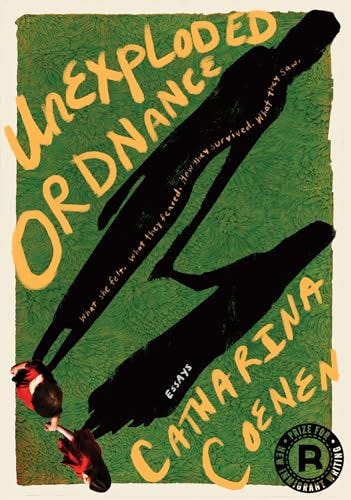
The title comes from the fact that Germany still has over 3,000 “unexploded ordnances,” bombs that fell during WWII that were buried deep in the ground during the war. Sometimes, a current citizen will discover a bomb, and a specialized crew will come to dig up and disable this device. Like the bombs themselves, pulling up the stories from her mother and grandmother requires careful reflection, questioning, and imagination. Coenen does this very well.
Imagine: through a strange series of events, a diary from the mid-1800s lands in your lap. And it’s written by your great-great-great-great grandfather. And each of the daily entries is written in code. And this code was translated into English by someone else.
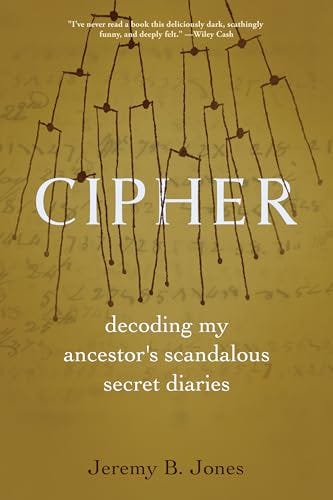
No, Jeremy B. Jones’ Cipher: Decoding My Ancestor’s Scandalous Secret Diaries is not a fantasy or time-travel book. It’s a true story of a writer who moves back to his rural family home in North Carolina and uses the experiences in his ancestor’s diary to question and navigate his own way through his role as a husband, father, and white man in the South. It’s a fascinating read that shifts between the experiences of the author and the experiences of his long-dead relative.
It’s a great book that speaks to the idea of heritage: of what we carry, and what we choose to leave behind.
Also read:
T.J. Klune’s Under the Whispering Door, a completely different story than The House on the Cerulean Sea, but just as delightful – a heartfelt and wonderfully sappy ending.
Kate Bauer’s How About Now, her newest collection of utterly accessible and often funny poems about being a woman and a mom in our contemporary culture.
Ellen Lord’s Vigil, a completely different collection of poems about age and loss and keeping watch over all that we hold dear.
That’s what I have to share for now. Any other thoughts on what I should be reading or recommendations for others, let me know! Happy reading, friends.
So happy to see TJ Klune on this list!! Huzzah!!